Zhenbang medical equipment-medical care bed, home care bed, massage bed series



产品中心

Characteristics of elbow crutches: 1. Support and Stability Provide reliable support for users. The design of the elbow crutch allows the user to transfer a significant amount of body weight onto it. For example, when a person with an injured leg is walking, the elbow crutch can bear part of the body's load, reducing the pressure on the injured limb. The base of the crutch usually has a non - slip rubber tip. This helps to ensure stability on various surfaces, such as smooth floors or slightly uneven pavements. It minimizes the risk of slipping and falling. 2. Adjustable Features Many elbow crutches are adjustable in height. This is very important as it can be customized to fit the user's height. For instance, a taller person may need a taller crutch setting to ensure proper alignment of the arm and body while using it, and a shorter person can adjust it to a lower height for comfortable use. Some elbow crutches also have adjustable elbow cuffs. The cuff can be tightened or loosened to fit different arm sizes snugly. This not only provides a more comfortable grip but also ensures that the crutch remains in the correct position during use. 3. Ergonomic Design The elbow cuff is designed to fit around the forearm and elbow area ergonomically. It is usually padded to reduce pressure on the elbow and forearm, preventing discomfort or chafing during long - term use. The handle of the elbow crutch is also designed with ergonomics in mind. It has a shape that fits comfortably in the hand, allowing the user to grip it firmly and easily control the movement of the crutch. 4. Portability Elbow crutches are relatively lightweight compared to some other mobility aids. This makes them easy to carry around. For example, if a person needs to use public transportation or go up and down stairs, the lightweight nature of the elbow crutch allows them to be easily transported and maneuvered. They can be folded in some cases. Folding elbow crutches are very convenient for storage and travel. They can be easily stored in a small space, such as a car trunk or a closet at home.
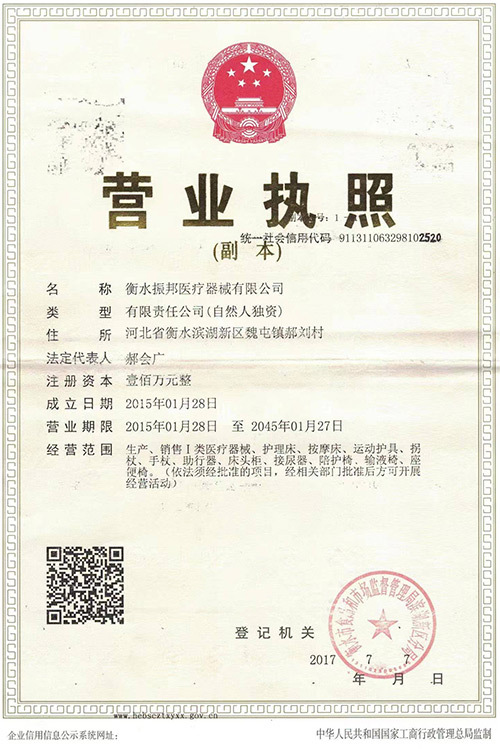
Specializing in medical equipment research and development, production and sales of the company, the main products include massage beds, beds and other medical equipment. Since its establishment, the company has been committed to providing high-quality medical device products and services to meet customer needs. Our massage bed and hospital bed products enjoy a good reputation in the market, by the majority of users trust and praise. Hengshui Zhenbang Medical Devices Co., Ltd. has a professional R & D team, constantly innovating and improving product quality and performance. Our products use high-quality materials and advanced production technology to ensure the durability and safety of the products. Our sales network throughout the country, for hospitals, clinics, nursing homes and other medical institutions to provide a full range of services. We always adhere to the customer as the center, providing personalized solutions to meet the special needs of customers. Hengshui Zhenbang Medical Equipment Co., Ltd. pays attention to brand building, and improves brand awareness and reputation through continuous promotion and publicity. We actively participate in medical equipment exhibitions and exchange activities at home and abroad, and maintain good communication and cooperation with peers and customers.
Mobile convenience: Usually equipped with wheels, it can be easily moved indoors, facilitating users to transfer between different locations such as from the bedroom to the bathroom. Especially for people with limited mobility, it greatly improves the convenience of life. Height adjustable: The height can be adjusted according to the user's height and needs to ensure that users are more comfortable and safe when sitting down and getting up, reducing the pressure on the waist and legs.
Good support base: The four-legged construction provides a wider support surface than a one-legged or three-legged cane. This makes the cane less prone to tipping over when the user is standing or walking. For example, for elderly people with poor balance or those with limited mobility, a four-legged cane can form a stable support structure on the ground, like a small stable platform. Adaptation to various surfaces: On uneven surfaces such as a stone pavement outdoors or a carpeted surface indoors, the multiple supports of a four-legged cane can better distribute pressure and adapt to the irregularities of the surface. Even if one leg falls into a small pit or the pile of a carpet, the other legs can still provide effective support, reducing the risk of the user falling or losing balance. In the second aspect of safety: Low center of gravity: Due to the distribution of the four legs, the center of gravity is relatively low. During use, when the user transfers part of the body weight to the cane, the low center of gravity helps prevent the cane from tipping over due to too high a center of gravity. Especially when turning or when the body is swaying, a four-legged cane with a low center of gravity can better maintain stability and ensure the safety of the user. Reliable braking (some four-legged canes): Some four-legged canes are equipped with special anti-slip pads or rubber covers on the legs, which can increase the friction with the ground. This anti-slip design on wet surfaces, such as the tiled floor of a bathroom or outdoors on a rainy day, effectively prevents the cane from sliding and further increases the safety of use. In the third aspect of ease of use: Self-supporting: A four-legged cane can stand on its own on the ground. When the user does not need the cane, for example, when sitting and resting or when needing to hold something with both hands, the user can conveniently lean the cane against the wall or leave it standing by itself nearby without worrying about it tipping over. This is more convenient than a one-legged cane. Ease of use: For users with weakened hand strength or poor coordination, a four-legged cane is relatively easier to use. Because it does not require the user to control balance and direction as precisely as with a one-legged cane. The four-legged structure itself provides a certain ability to automatically maintain balance and reduces the difficulty of use.
Hengshui Zhenbang Medical Equipment
No. 658, south side of Pingyuan Street, South District, Innovation Lane, Zaoqiang Town, Hengshui City, Hebei Province.
Mobile